


Within 2-8 years, a Quantum machine will break Bitcoin’s cryptography. The time available to upgrade Bitcoin before Q-Day is rapidly closing. Without change, Satoshi’s coins will be market dumped.
[ORIGINALLY PUBLISHED ON SUBSTACK ON 20 FEB 2026 HERE]
The biggest threat to Bitcoin is quantum computing. Within the next 9 years quantum computers will be able to break Bitcoin’s current cryptography and classic RSA encryption. The moment in time this happens is known as “Q-Day”.
In this article we:
- Prove that quantum risk is already being priced into Bitcoin today.
- Present a model to calculate the probability of Q-Day occuring.
- Explain why it will take about 2 years to upgrade Bitcoin to be quantum proof.
- Present a framework for calculating Bitcoin’s Quantum Discount Factor, the percentage that the fair value of Bitcoin should be reduced to allow for the threat of quantum hack.
- Show that Bitcoin in $60Ks is undervalued today, despite the quantum risk.
- Justify why Bitcoin is the number one target for quantum hackers and why most banks are not at risk.
The quantum threat devalues Bitcoin
A quantum hack would compromise the core tenets of Bitcoin.
“Trust the code” and “hard money” value propositions would be crippled overnight as up to 30% of all Bitcoin supply (coins with exposed public keys) are stolen and liquidated. As a result, logical market participants must now discount the fair value of Bitcoin by the same probability that Q-Day occurs within a forward 2 year window (the time required to upgrade).
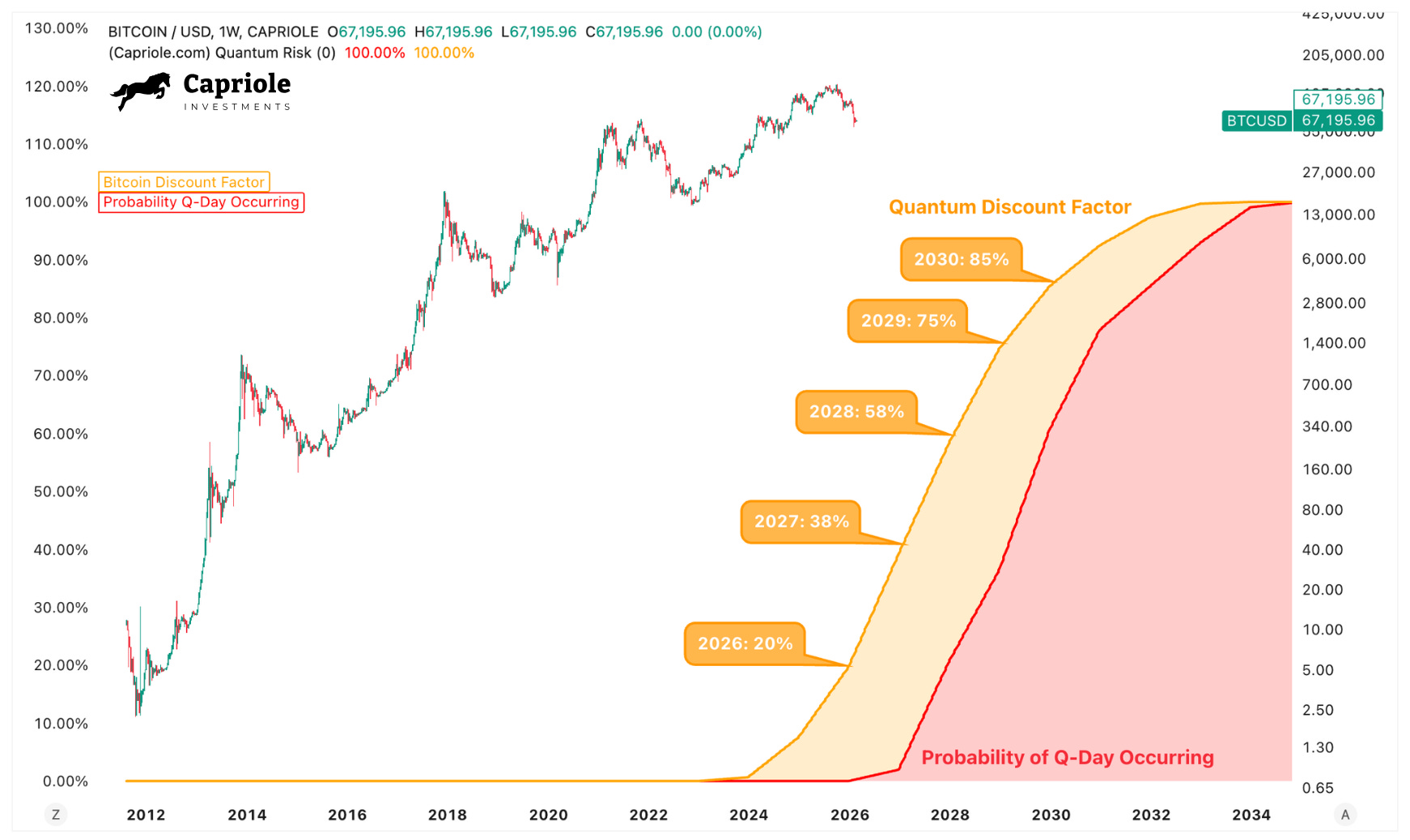
As of writing there is a 20% chance Q-Day occurs by 2028, so we argue the fair value of Bitcoin should be reduced by 20% today.
However, as time marches forward we must see measured progress toward quantum proofing Bitcoin. Every year that passes without progress increases the quantum discount that needs to be applied to Bitcoin at an alarming rate.
In this article we show that the Quantum Discount Factor is 20% today, but without action it also jumps to 38% in 2027 and 58% in 2028.
2025 should have been a standout year for Bitcoin
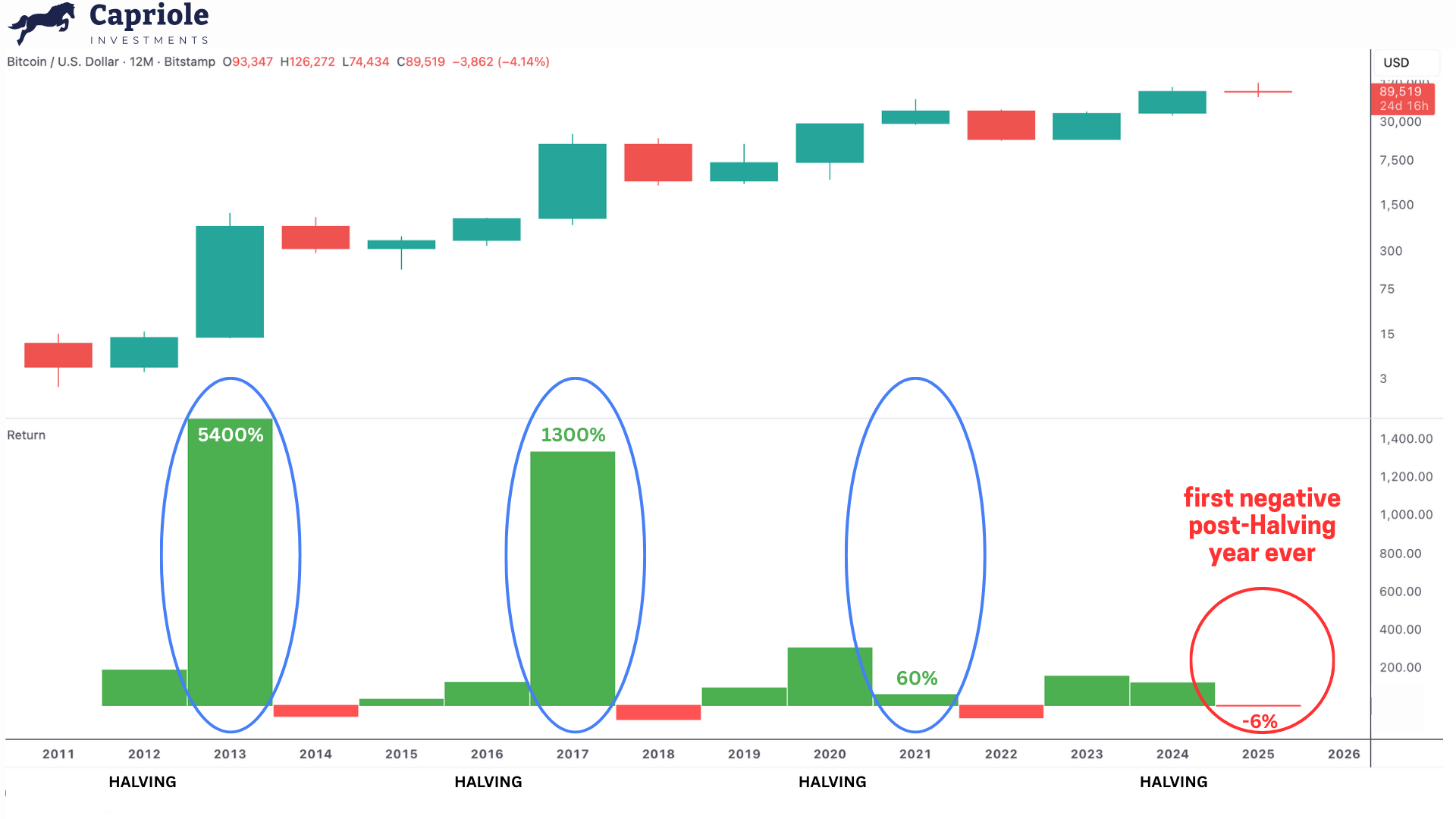
Through all of Bitcoin’s history, all post-Halving years have been big winners, because the Halving creates a supply squeeze that drives price up. 2025 was the first negative post-Halving year.
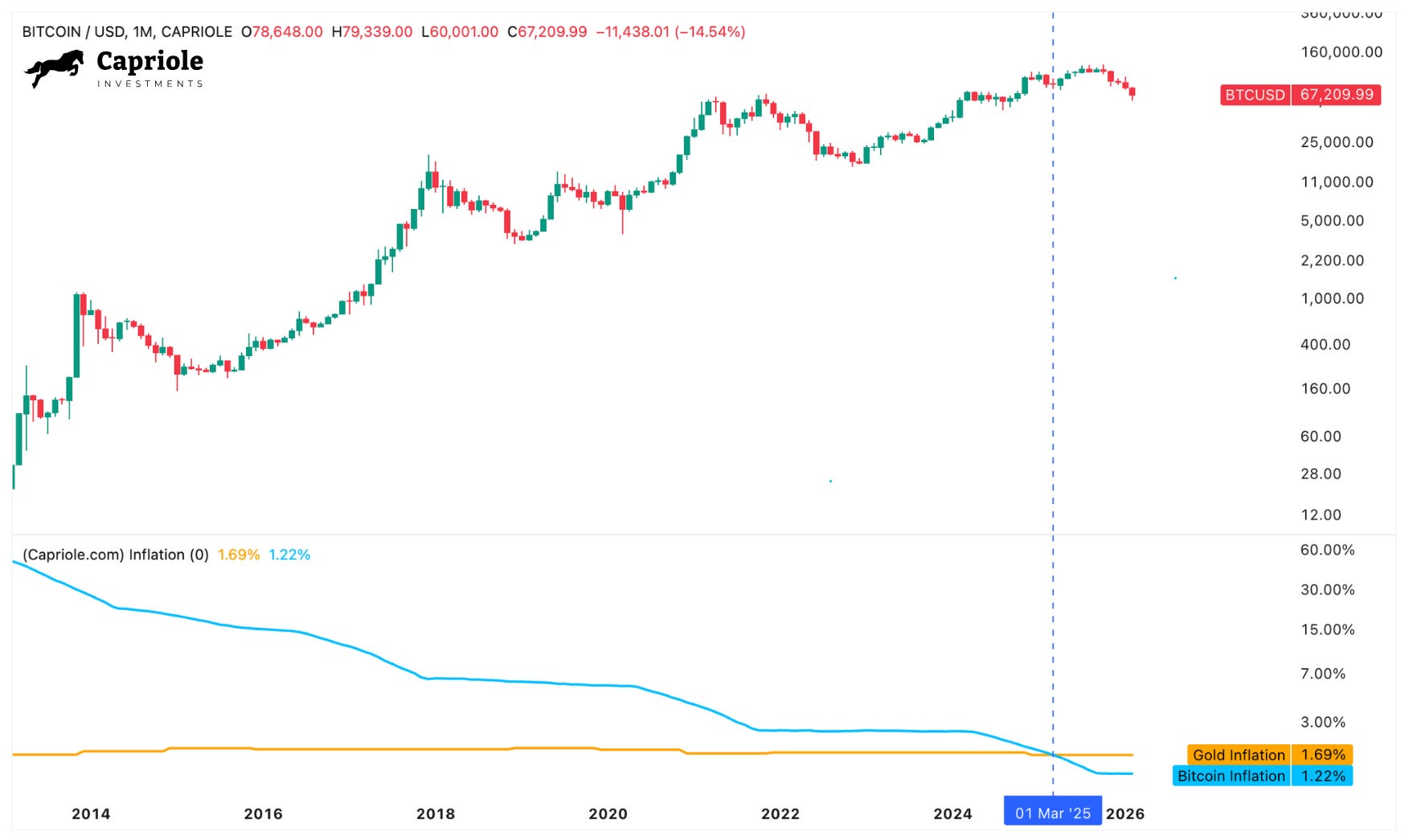
2025 was the first year Bitcoin’s annual inflation rate dropped below that of gold, making Bitcoin the hardest money in the world with has forward looking certainty of supply. Yet it underperformed gold.
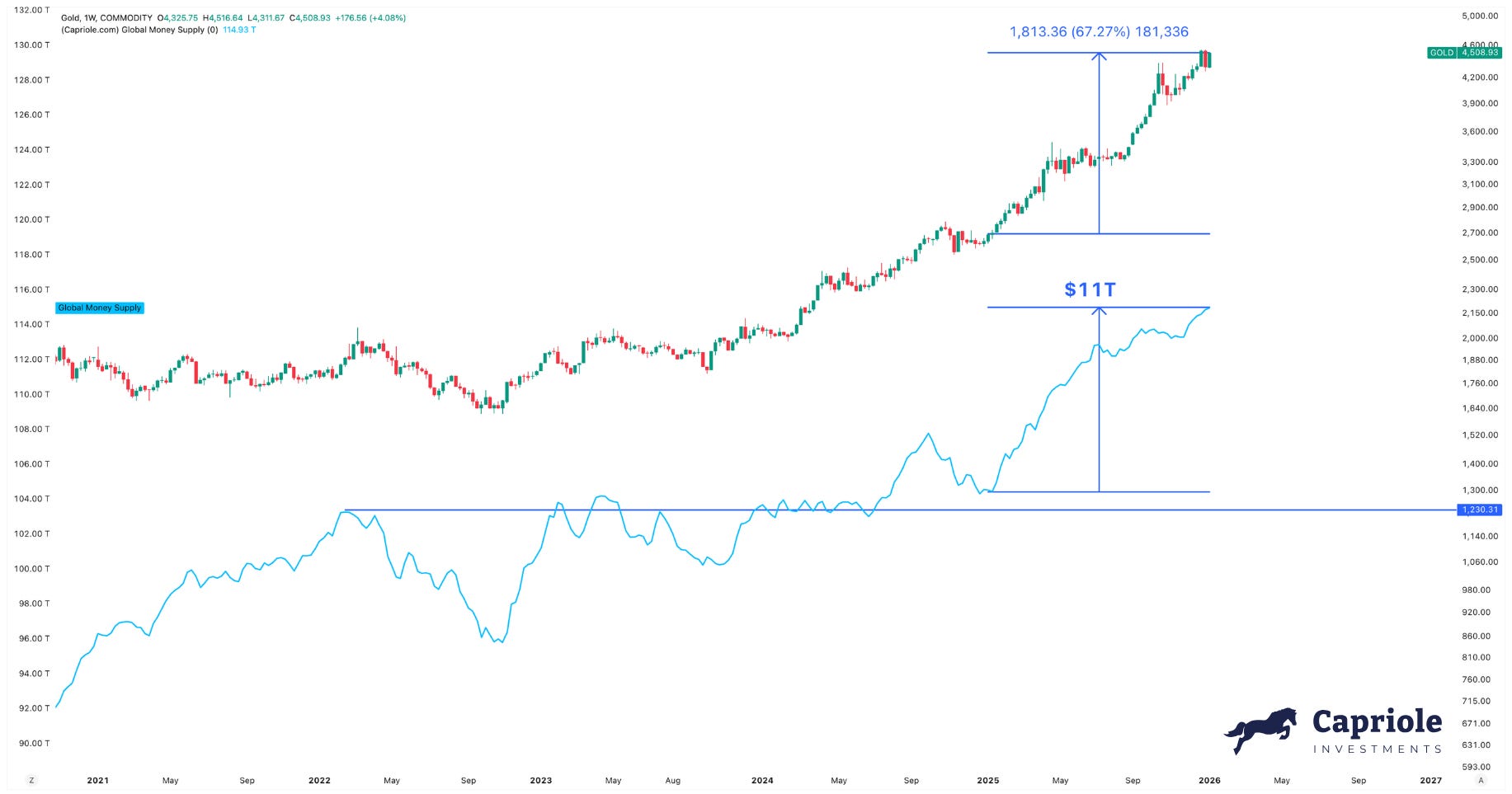
The global money supply grew at an astonishing 10.5% in 2025, as high as mid-2020 when stimulus checks were airdropped on a locked down population. This should be the optimal liquidity backdrop for Bitcoin – as it has been for Gold. Yet Bitcoin went down while Gold and equities skyrocketed.
Through all of Bitcoin’s history, it has never had a negative 2 year rolling correlation to Gold and gone down, until 2025. The only other time correlation was negative (2016) Bitcoin went up, and that was prior to any institutional adoption.
Historically, whenever Gold has a major rally, Bitcoin has followed within months (green on chart). But not in 2025.
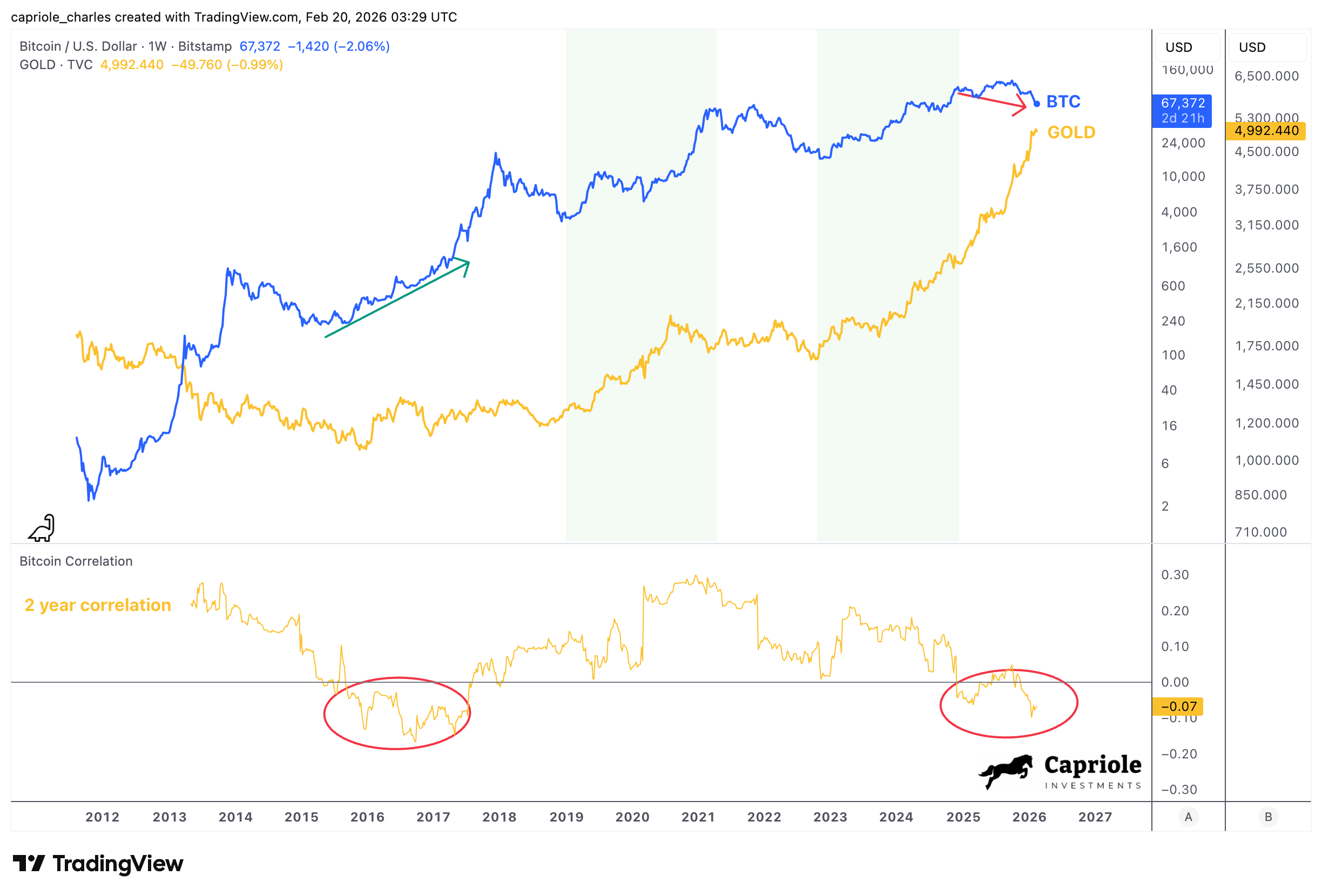
Bitcoin should be flying.
2025 had the optimal cyclical timing, the optimal supply squeeze dynamic, the optimal pro-Bitcoin US policy, a US strategic Bitcoin reserve, the optimal global money supply inflation, gold up over 50%, equities up double digits…
Yet Bitcoin went down.
Under these same conditions Bitcoin has historically shot the lights out.
What happened?
The market is already pricing quantum risk in
We have already started to see quantum risk be priced into Bitcoin. It’s the primary reason Bitcoin is trading -50% against the S&P 500 and -90% against gold since the inaugural Bitcoin Quantum Summit 7 months ago.
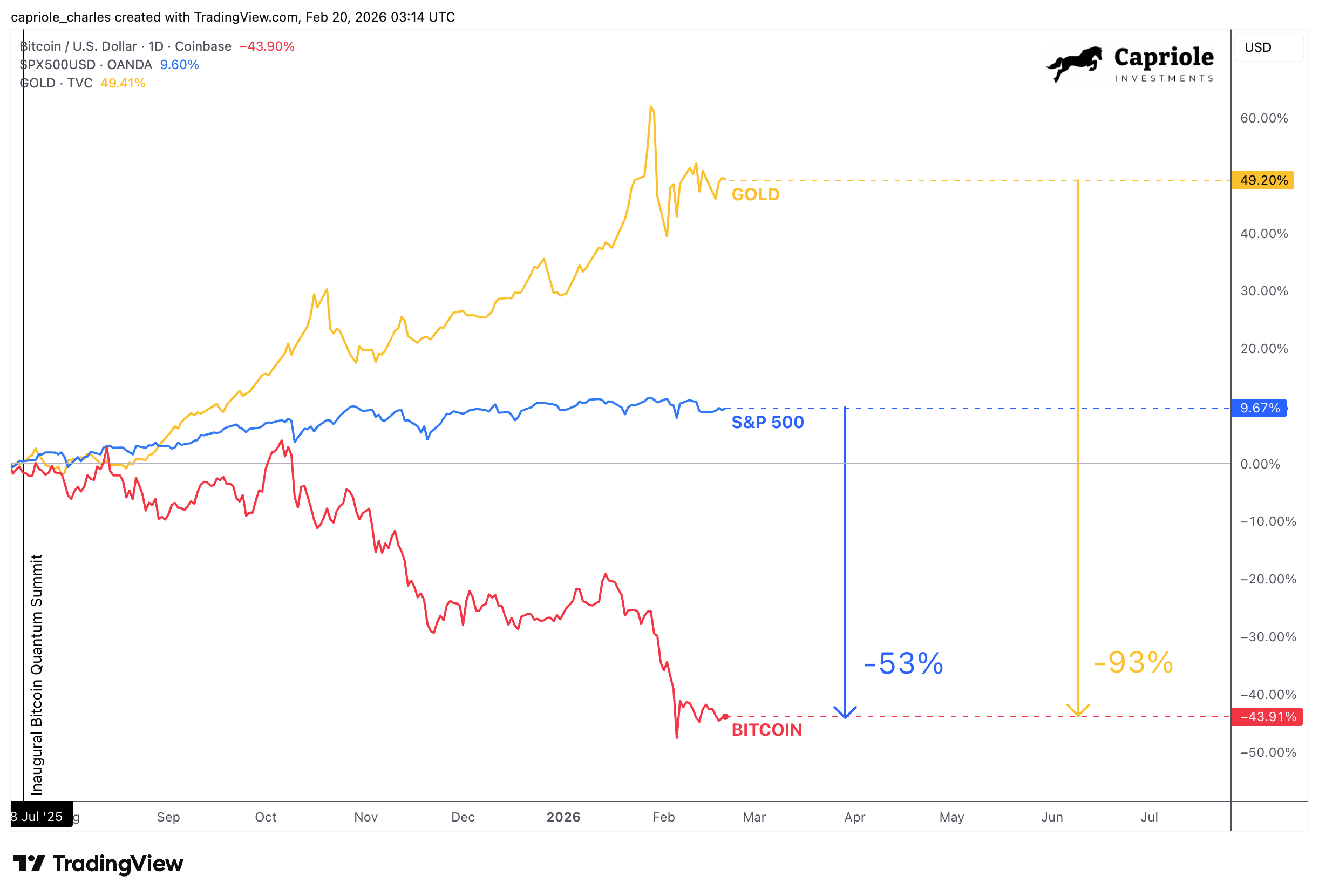
We entered the Quantum Event Horizon
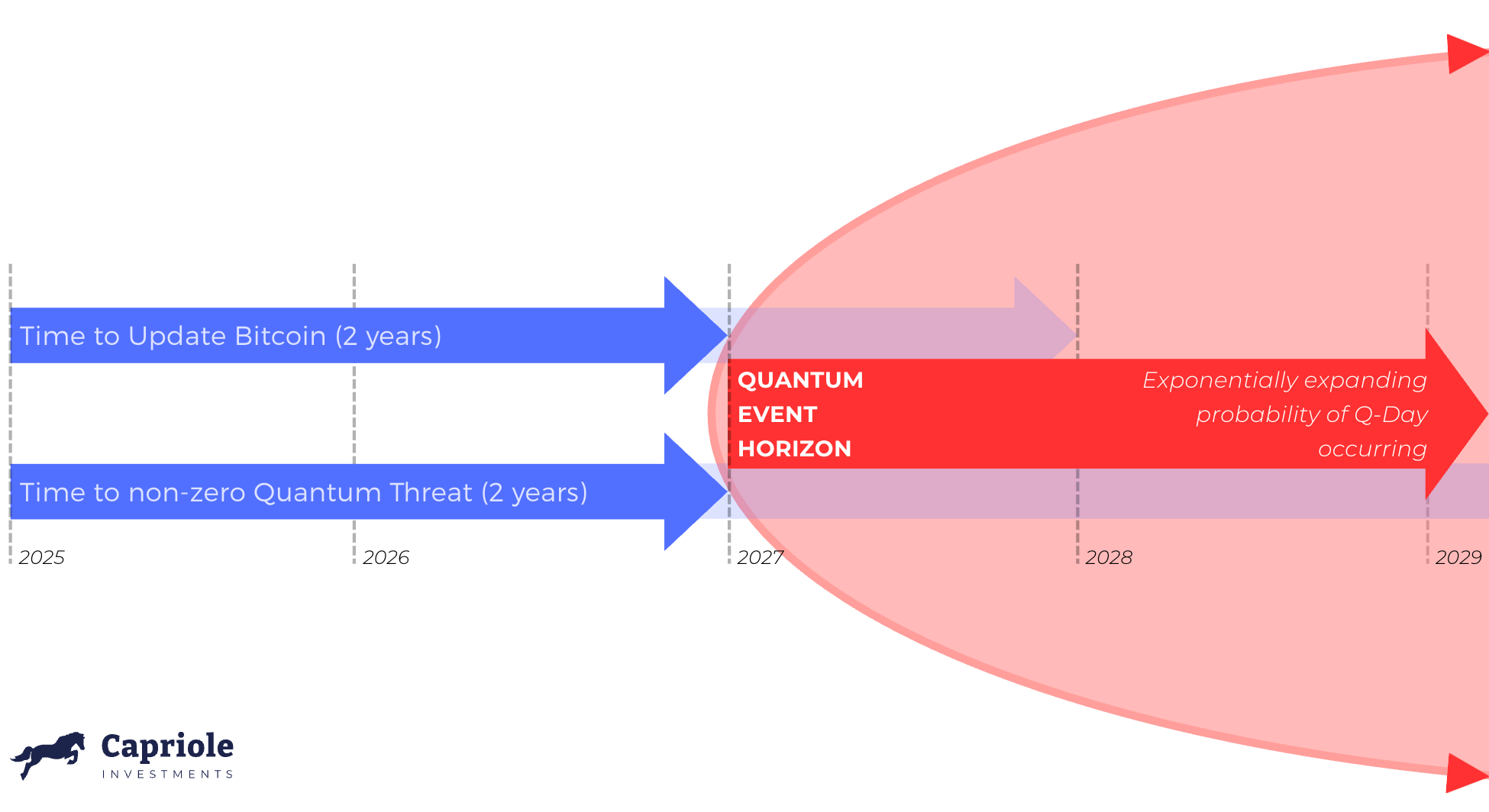
The reason for Bitcoin’s underperformance in 2025 is that it entered the “Quantum Event Horizon”.
This is the window where the time until a non-zero threat of quantum breaking Bitcoin is approximately the same amount of time as it will take to upgrade Bitcoin to being Quantum resistant (about 2 years, as explained later).
It is precisely for this reason we saw Bitcoin start to underperform and drift lower through 2025 against all other risk assets and stores of value like Gold. For the first time ever, market participants are now pricing in the risk of quantum computing and discounting the value of Bitcoin accordingly.
Don’t believe it?
Here’s what some of the biggest capital allocators in the world have been saying about the quantum threat and Bitcoin over the last 7 months as they distance themselves from it:
- “Van Eck has been around before Bitcoin, we will walk away from Bitcoin if the thesis is fundamentally broken… people are wondering is there enough encryption in Bitcoin because Quantum Computing is coming.” – CEO, Van Eck (Nov 2025)
- “The world’s largest asset manager, BlackRock, has quietly added a serious warning about quantum computing to the list of risks to its huge spot bitcoin ETF” – Forbes (May 2025)
- “The store of value concept is clearly on less solid foundation from [quantum]…for that reason we remove the 10% allocation to Bitcoin with 5% reallocated to gold and 5% reallocated to gold-mining stocks” – Head of Equities, Jefferies (Jan 2026)
- “Quantum computing concerns are keeping institutions cautious, limiting allocations to 3% until resolved.” – Kevin O’leary (Feb 2026)
Institutions have started to remove Bitcoin from their portfolios.
Breaking Bitcoin
Bitcoin uses Elliptic Curve Cryptography (ECC) for digital signatures and key generation, ensuring that private keys cannot be derived from public keys. Anyone holding a private key has complete control of the underlying Bitcoin. This security system works well today as it would take a modern computer billions of years to decrypt a public key and reveal the secret private key.
However, Bitcoin’s current cryptography completely fails in a quantum world. If current quantum computing progress continues as it has since 2020, and if Bitcoin doesn’t upgrade, a quantum hacker that knows your public key will likely be able to crack your Bitcoin private key within the next 9 years.
The magic of Quantum Computing
The seeming magic of quantum computers is their ability to use “Superposition” to simulate an unfathomably large number of potential solutions to a problem at the same time. Unlike normal computers that use discrete states of 1s and 0s to solve problems chronologically, quantum computers use “qubits” which can be 0, 1 or both at the same time. This allows exploring many states at the same time, solving complex problems exponentially faster. They solve the historically unsolvable.
2 years ago Google used a quantum machine to solve a problem in 5 minutes that would take a supercomputer 10 Septillion years to solve – that’s more time than the entire universe has even existed.
“Qubits” can be considered the processing power units of quantum computers. You will hear people distinguish between “physical qubits” and “logical qubits.” Physical qubits are the raw, hardware-level processing units, while logical qubits are the error-corrected qubits which rely on many physical qubits to behave like a single, more reliable qubit.
It’s logical qubit counts that we generally care about when predicting the processing power necessary to run Shor’s algorithm, trigger Q-Day, break Bitcoins current cryptography and unlock expansive cross-industry innovations.
It turns out you only need about 2300 logical qubits (or around 100,000 physical qubits) to break Bitcoin’s cryptography, and five of the top global quantum computing companies are forecasting that capability within the next 2-5 years.
In the next decade, Quantum computers will unlock an exciting wave of new innovations across industries.
They will also break all classical encryption.
It’s here now
Many dismiss quantum computing given its early stage of development. Most don’t realize that quantum computers are already used today and deployed on all major cloud platforms (including AWS, Google Cloud and Microsoft Azure). Quantum computing is also actively used in various industries, including across material science, medicine, defense and finance.

Today quantum computing is still in its infancy. Much like ChatGPT was a primitive product in 2021. It’s the trend and rate of progress that we must pay attention to.
Threat Horizon moving forward
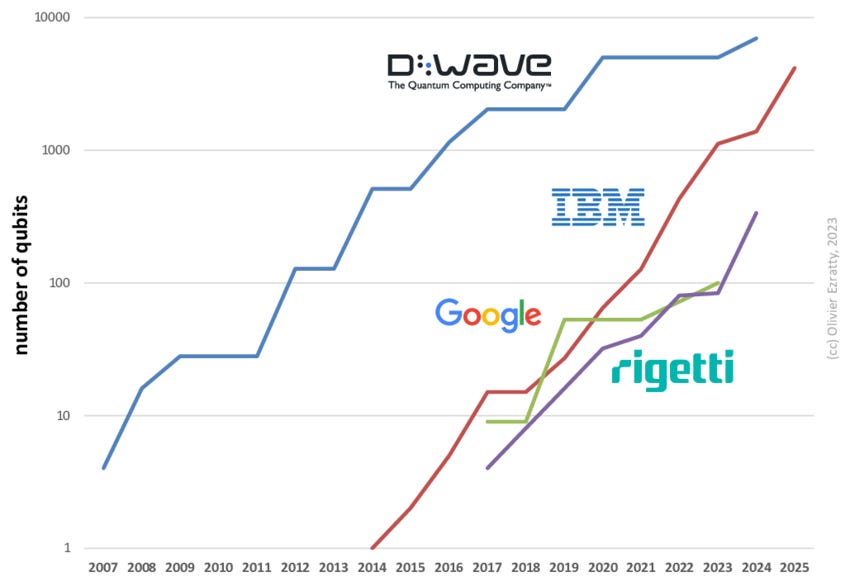
Over the last 5 years, timeframes and estimates for when Q-Day will occur have consistently been brought forward as quantum computing companies globally have exceeded their own roadmaps. Qubit counts have grown, and error rates fallen, exponentially and faster than expected.
Quantum is advancing faster than Moore’s Law
Moore’s law has defined the growth rate of current day computing for a century. Every 2 years the processing power of transistor chips has doubled. This has been achieved despite the various technological challenges that arose along the way and despite circuitry evolving from the visible scale to the nanoscale. Nothing has stopped this trend from continuing exponentially, it’s a near perfect linear trend on a log chart.
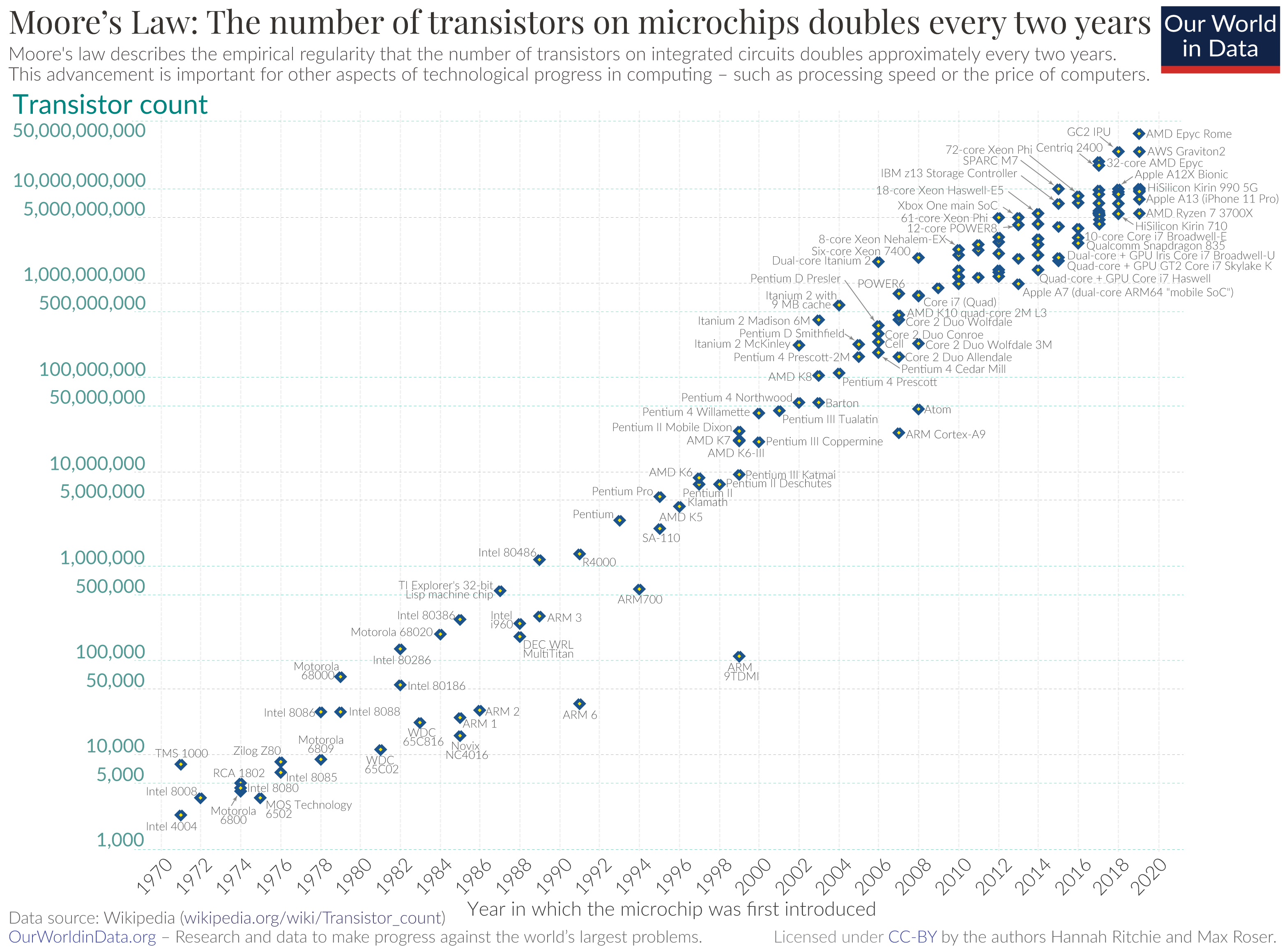
Quantum computing is similar, except it is advancing even faster than Moore’s law. Qubit counts have been doubling not every 2 years, but every 18 months. To date, no technological challenges have slowed the quantum trend.
If Moore’s law worked for a century without fault, and quantum computing also shows no signs of slowing down nor any foreseeable technological roadblocks, why wouldn’t we expect this trend to hold for quantum going forward also?
If it does, Q-Day will occur within the next 9 years.
The consistency and linearity of advancement in quantum computing actually makes it one of the easiest trends to forecast with reasonable confidence in accuracy.
Predicting Q-Day
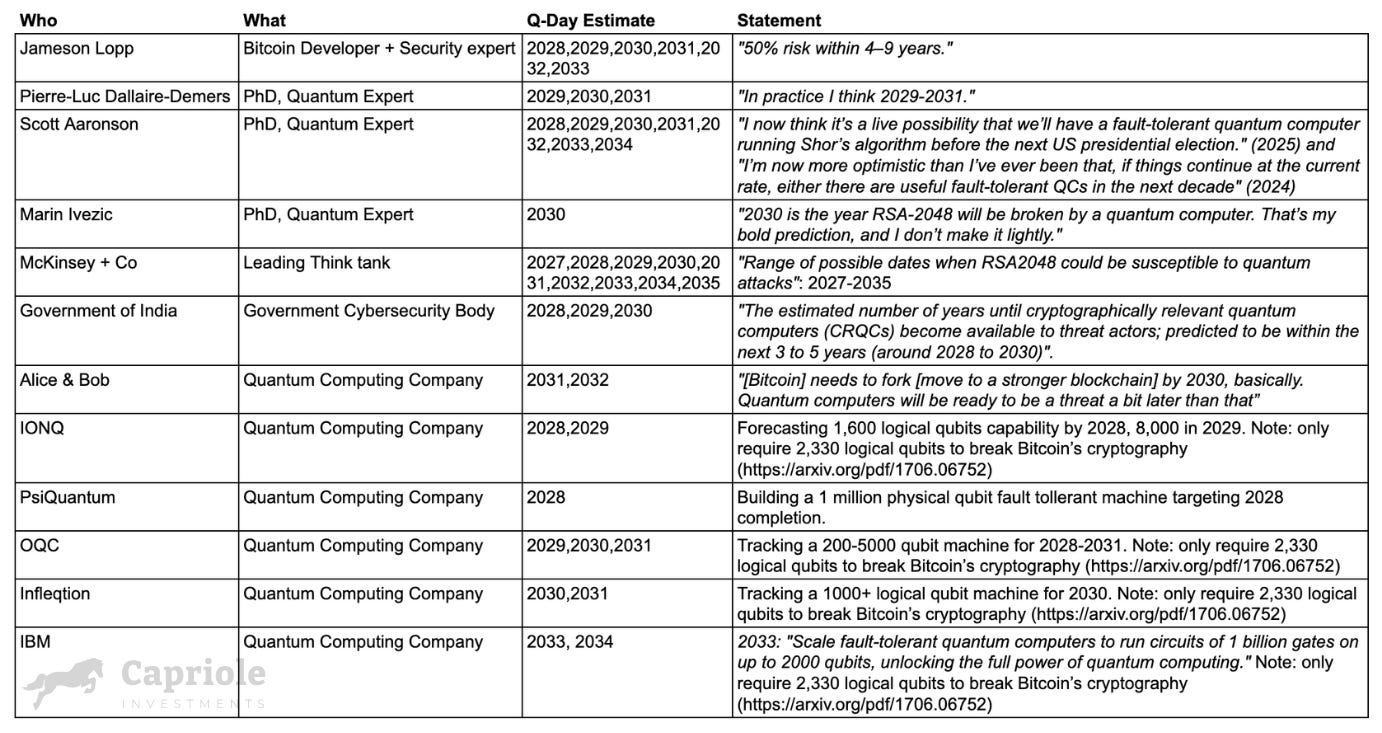
We’ve surveyed Q-Day estimates from qualified quantum physicists, cyber security councils and the top quantum computing companies globally. Where a major quantum company’s official statement or roadmap includes a logical qubit count in the multi-thousands, we consider that sufficient to break Bitcoin’s cryptography, as 2300 logical qubits is the generally accepted threshold required.
If you collate these industry expert estimates for when Bitcoin’s Q-Day is expected, you will find that Q-Day will almost certainly occur within the next 2-9 years and with high probability from from 2030.
The Probability of Q-Day occuring
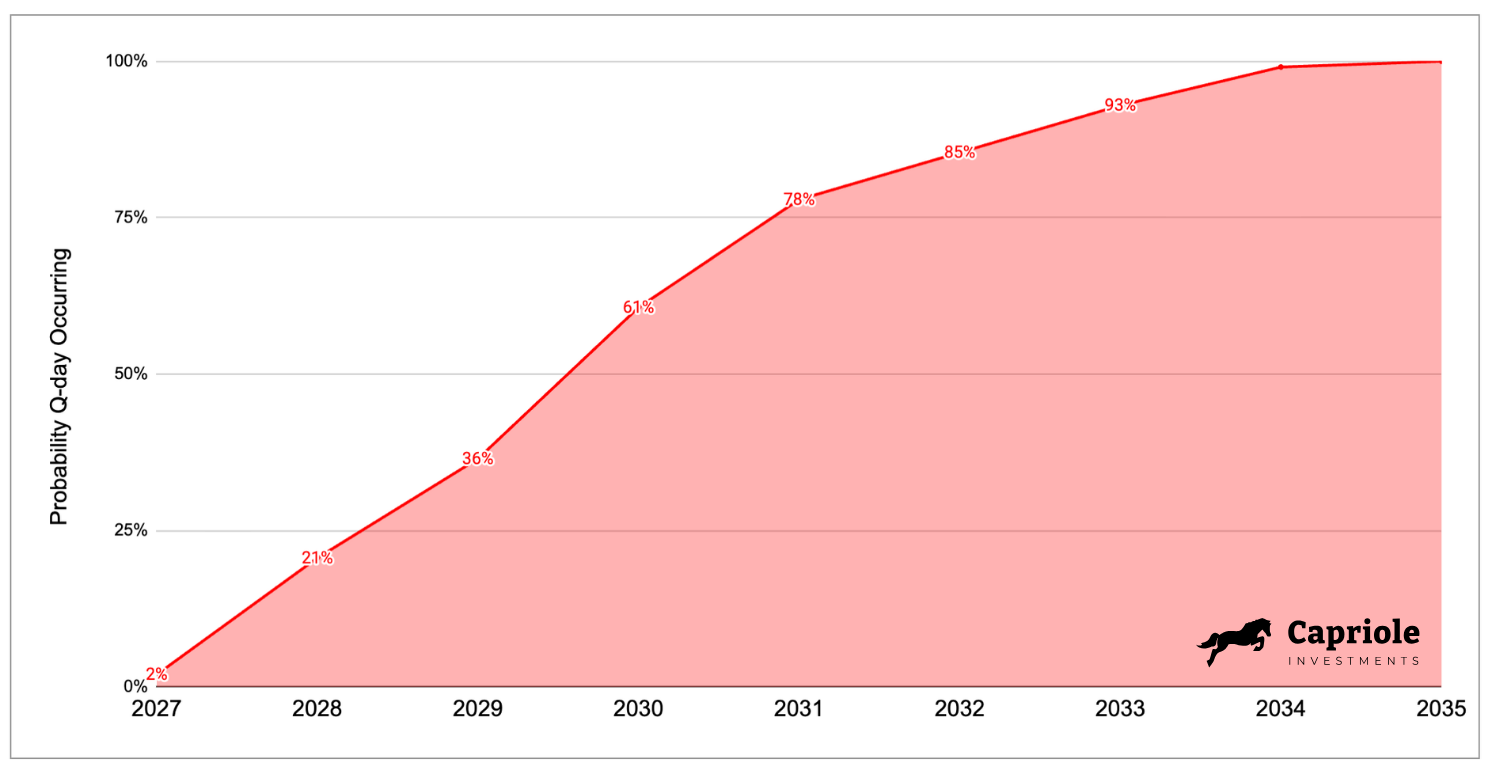
Using this data, we calculate the probability of Q-Day occurring per year using a discrete probability distribution (probability mass function). Each expert’s Q-Day estimate year (or range of years) is treated as equally likely to occur. So we simply add the probabilities by year, then average them so each source has an equal weight. The full calculation logic is available here.
As the below chart shows, this gives a powerful finding. Q-Day threat to Bitcoin is not 20 years away as some would like to think.
Bitcoin Q-Day is likely to occur by 2030 (60% chance) and probable by 2031 (80% chance). Furthermore all of the expert estimates, which includes 6 of the world leading quantum computing companies, fall within the next 9 years.
Note that we haven’t included Quantinuum yet, the current world leader in quantum computing. In 2025 they achieved 50 logical qubits. Several companies are expecting well over 100 logical qubits in 2026.
Bitcoin is slow at Upgrading
Bitcoin is slow at upgrading. Changes to the code must filter through the Bitcoin core developer team, be tested, improved, reach consensus, deployed, accepted by nodes, exchanges and miners and have users migrate. This decentralized process makes agreement, deployment and utilization of new code a time consuming matter. While this is normally good for the preservation of Bitcoin’s values (like the fixed 21 million coin supply “hard money” tenet), in the era of quantum computing we do not have the luxury of time.
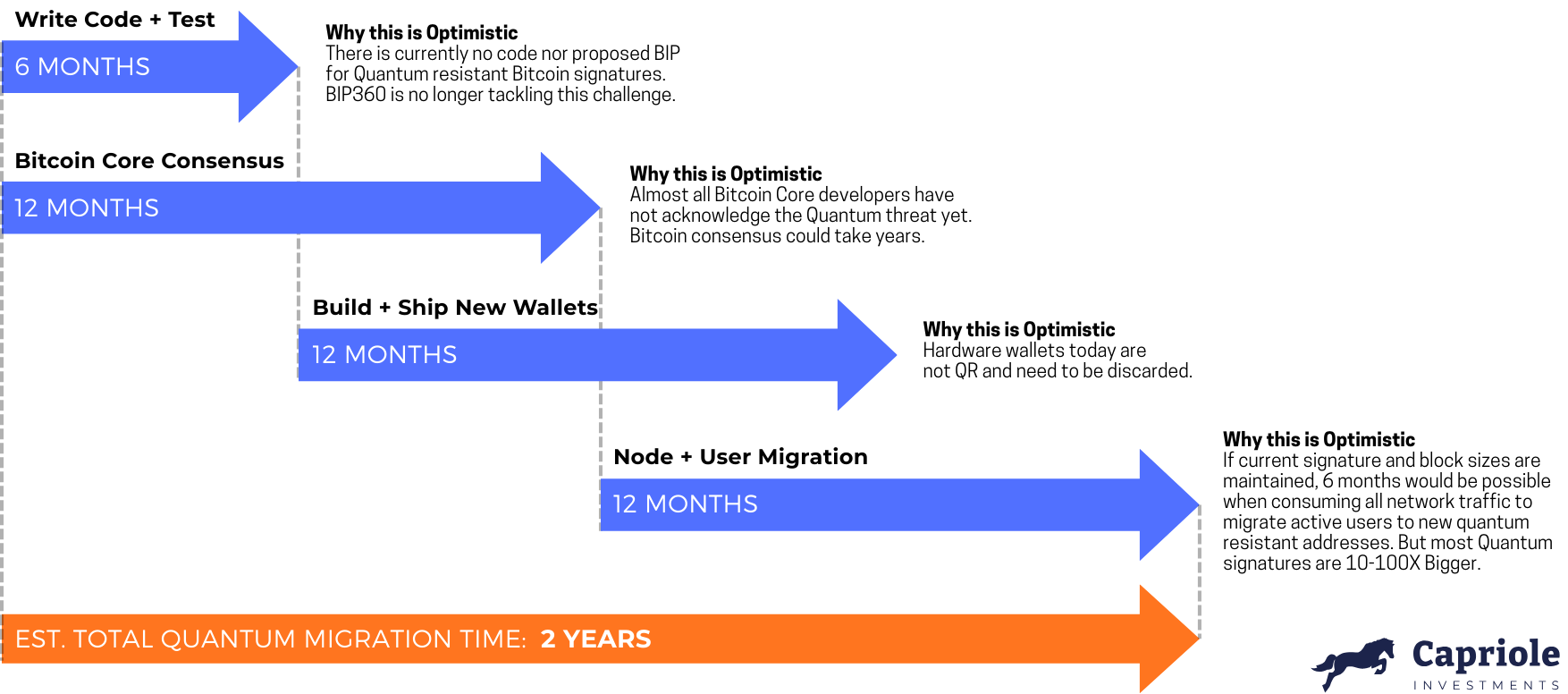
Realistically the timeframe to update Bitcoin code and migrate the majority of active users across to quantum resistant wallets and addresses is approximately 2 years. In an extremely optimistic and aggressive scenario this might be feasible in 1 year, but is more likely to be closer to 3 years, as the below diagram elicits.
We can’t afford to be 1 day late
One of Bitcoin’s core tenants is “trust the code”.
To date Bitcoin has been a profound and innovative technology in eliminating the risks associated with the fickleness of human counterparty trust. But if a quantum computer successfully decodes public addresses, and market sells the 20-30% of circulating Bitcoin that is public key exposed, it will be very hard to stand by the philosophy of “trust the code” as coins start to saturate exchanges and drive price down.
If a quantum hacker can acquire 20% of the supply and unload it on the market is Bitcoin still “hard money”?
Trust is hard to gain and easily lost. It took Bitcoin 17 years to get to where it is today and a Q-Day event like this would be catastrophic to worldwide trust in Bitcoin. If such an event were to occur we expect this will result in the biggest bear market we have ever seen and potentially the total failure of Bitcoin altogether.
Because there is a massive and potentially catastrophic outcome if Bitcoin does not upgrade to quantum resistant code before Q-Day, and because we are now inside the Quantum Event Horizon, all rational Bitcoin investors are now discounting the value of Bitcoin by the probability of Q-Day occuring in the same window of time it takes to upgrade Bitcoin (1-3 years). This is why since 2025 we have seen allocators selling down Bitcoin and reducing holdings as the quantum threat to Bitcoin expands.
Bitcoin’s Quantum Discount Factor
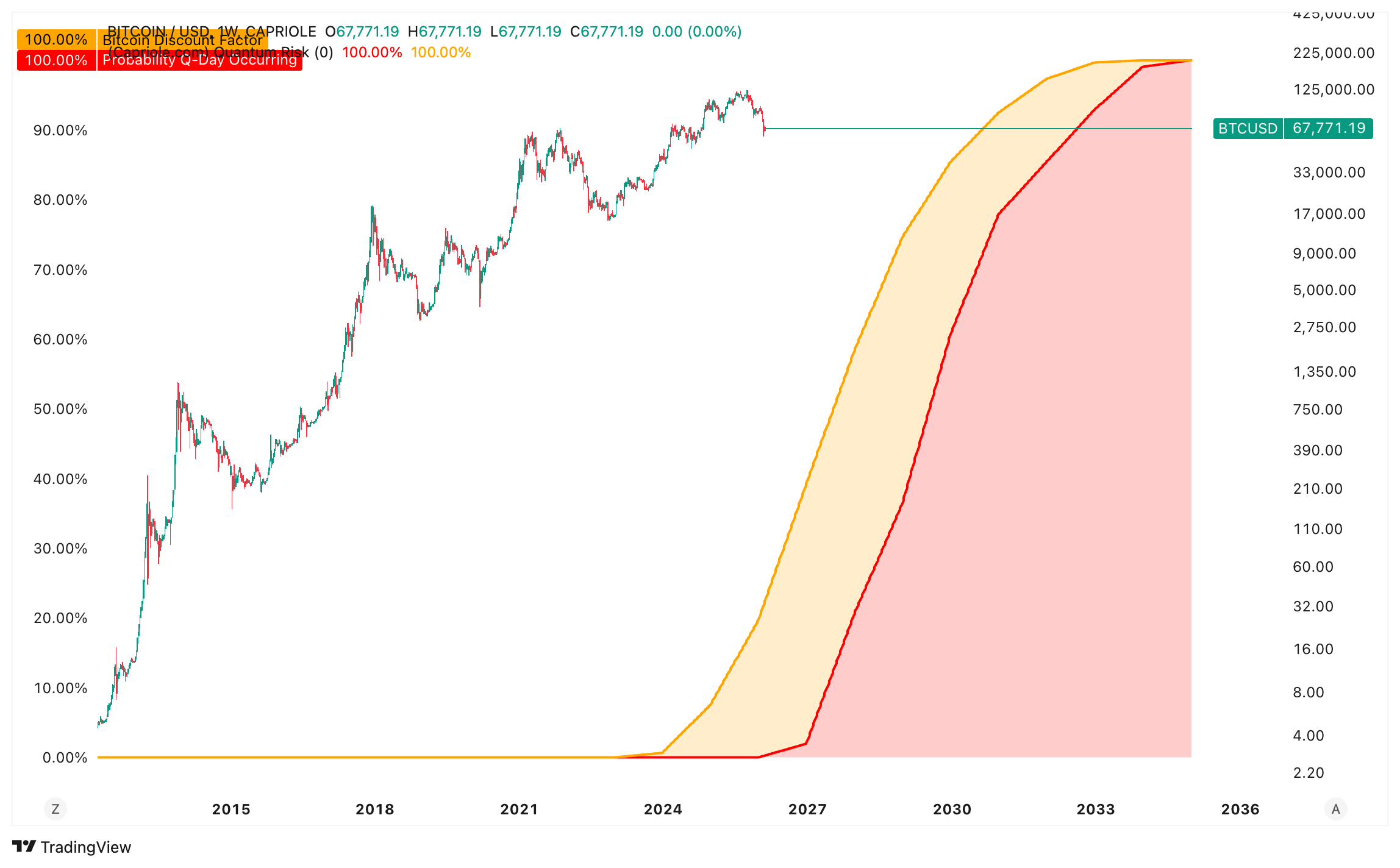
The Quantum Discount Factor is the percentage we need to discount the value of Bitcoin for the probability of Q-Day occuring. It is calculated as the cumulative probability of Q-Day occurring by year (data as per earlier chart), less the number of years to upgrade Bitcoin. The discount factor assumes no changes to current Bitcoin code and assumes the value of Bitcoin is zero if Bitcoin Q-Day occurs and Bitcoin hasn’t upgraded. Because we don’t know for sure the time it will take to upgrade Bitcoin and migrate all users, we run the three most probable outcomes (1, 2 and 3 year upgrade and migration times) and finally average the three to estimate the discount factor that should be applied to Bitcoin’s value at any point in time. You can view all calculations here.
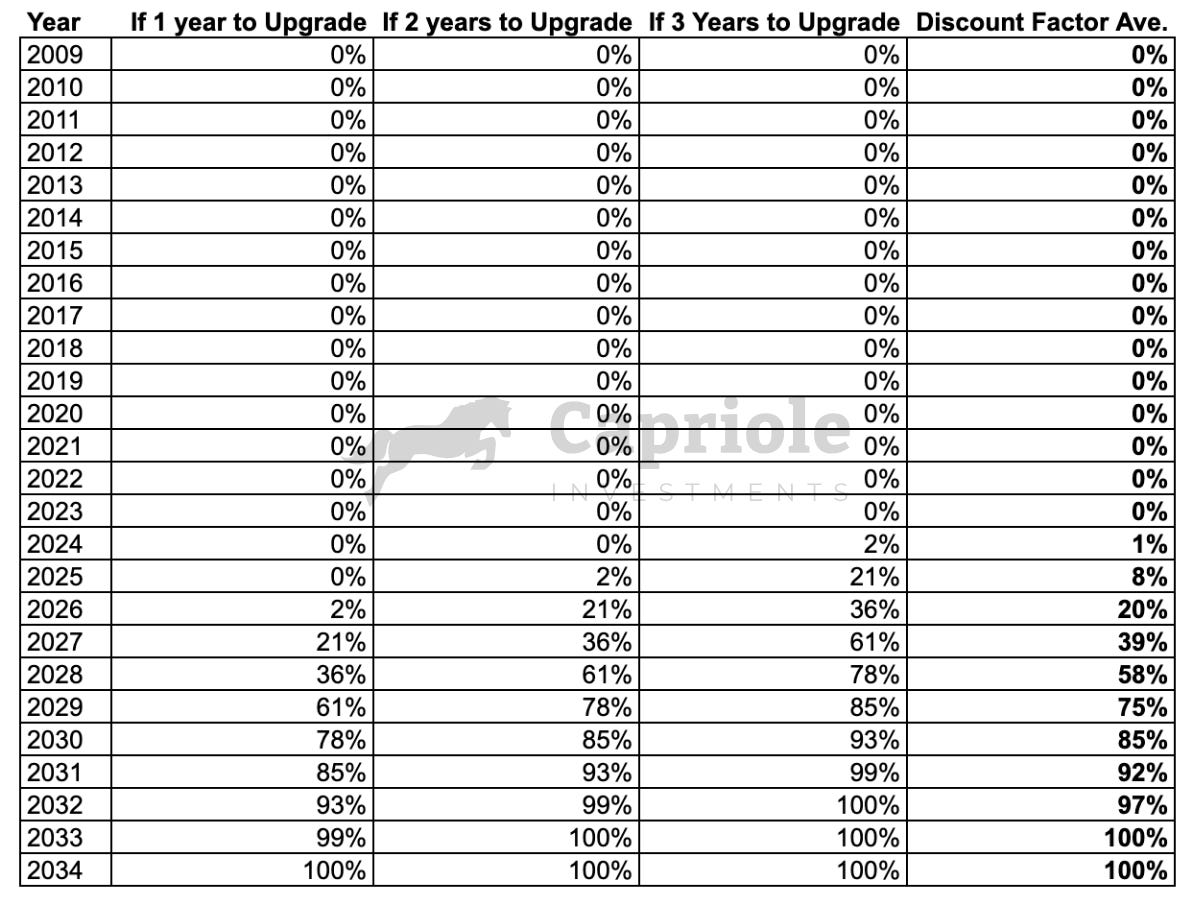
Here’s how the average Bitcoin Quantum Discount Factor looks.
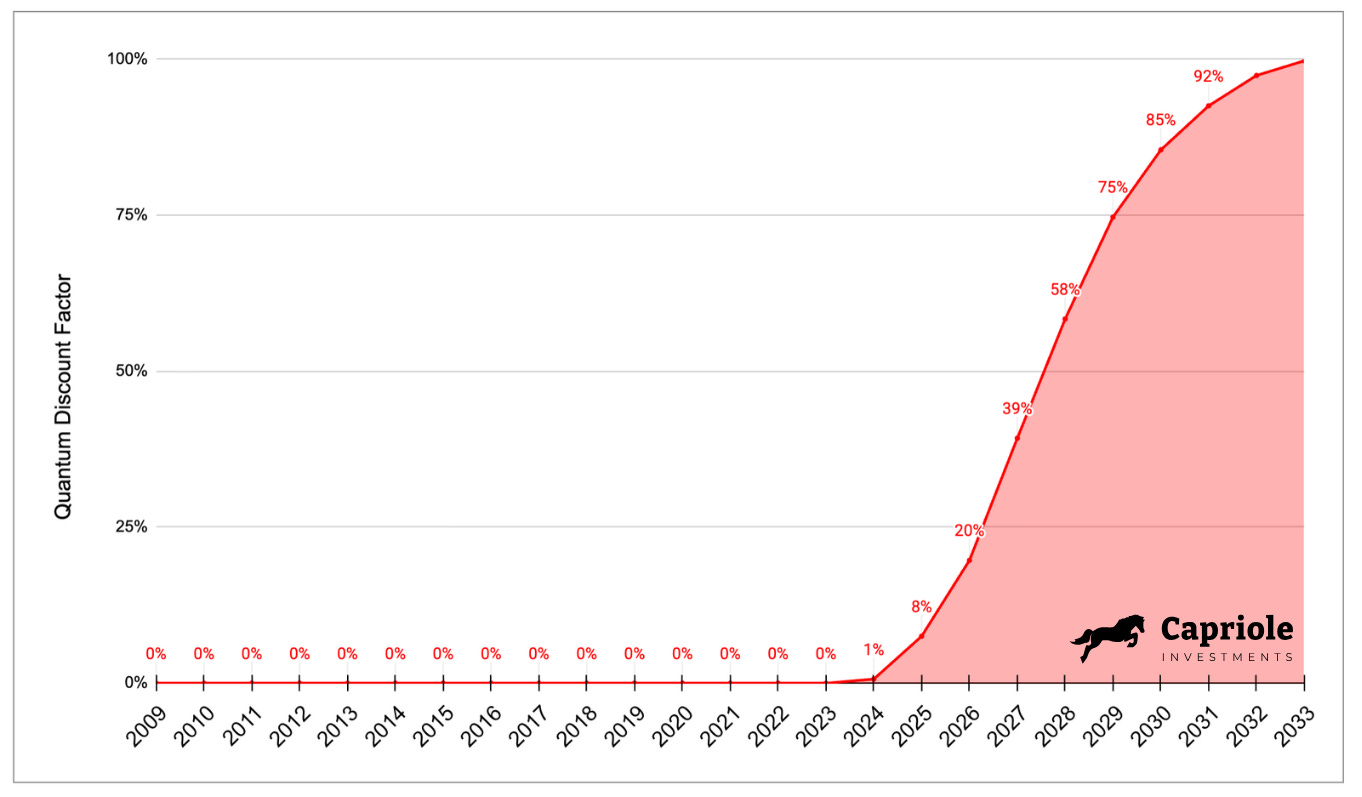
Through all Bitcoin’s 17 years of history, the risk of a cryptographically relevant quantum computer (CRQC) existing, powerful enough to break Bitcoin’s encryption was zero. That all changed in 2025. As of writing in 2026, the logical market participant that is informed about the current state and trend of quantum computing is now discounting the fair value of Bitcoin by over 20%.
The aggressive growth rate of this risk is alarming.
Bitcoin will be worth half as much in little over a year if we do not progress an upgrade to quantum proof Bitcoin. Without progress, Bitcoin’s Quantum Discount Factor jumps to 75% in 2029.
It is precisely for this reason that for the last year we have been strongly advocating that Bitcoin must make significant traction on upgrading to be Quantum resistant in 2026.
That’s this year.
Bitcoin has two big problems to solve
Bitcoin has two key problems to address as they relate to the quantum threat:
- Problem 1: Migrate active users (70% of supply) to a quantum proof Bitcoin fork.Technically feasible. Codable solutions exist today, but no Bitcoin Improvement Proposal (BIP) with quantum resistant signature code has been written to address this issue to date. Hopefully 2026 is the year this happens.
- Problem 2: Freeze the lost / public key exposed coins (20-30% of supply).20-30% of Bitcoin’s supply is public key exposed and ready to be taken by a quantum hacker post Q-Day. Once a large wallet is decrypted, like Satoshi’s $100B+ or any other large Bitcoin rich list or exchange wallets, a quantum hacker will be incentivised to immediately liquidate the funds – just in case another quantum hacker is right behind them in the process of doing the same. Game theory incentives selling. Tens of Billions, then hundreds of billions of dollars of Bitcoin will flood into exchanges as first the hackers, then the general public look to cash out, causing the biggest sell pressure Bitcoin has ever seen. We have two options to solve address this problem:
- Option A: let the quantum hacker take and liquidate coins.
In this “do nothing” scenario we accept a massive supply overhang on Bitcoin that could last years. Just as the average altcoin falls -95% due to significant supply overhangs and VC selling (the average return of new coin listings in 2025 was -95%) this will likely see Bitcoin go through the biggest bear market it has ever seen. “Trust the code” mantra will collapse. People will question the value proposition of Bitcoin and reputational recovery is uncertain. FTX will look like a cake walk. - Option B: Deploy a Bitcoin dead man’s switch.
Following migration to the quantum proof fork (problem 1 above) we implement a “dead man’s switch” to freeze coins that do not migrate to the quantum proof fork within a certain period of time (eg. 1-2 years). Provided such a solution is implemented in time, this is the only option that will ensure 100% quantum proof security of Bitcoin and no quantum hacking. It would ensure “trust the code” and “hard money” tenets are maintained and eliminate the possibility for a quantum bear market. It would preserve the most wealth across the network. However, this is a philosophically difficult decision for many to make, as it would (to a limited extent) sacrifice the “not your keys, not your coins” Bitcoin value proposition, as those who are unable to access their coins and migrate in time will permanently lose their wealth. Despite this we believe the Dead Man’s Switch is the best pathway to maximize the value of Bitcoin and preserve the most wealth for the existing and active 20 million + holders globally. It’s likely less than 0.01% of users would be negatively affected here, making this solution the significant lesser of two evils. Nonetheless we acknowledge that getting consensus on this will be extremely challenging and at this stage we expect it is unfortunately unlikely to happen.
- Option A: let the quantum hacker take and liquidate coins.
For the purpose of this article, when we talk about “upgrading Bitcoin” to being “quantum proof”, we mean addressing both of the above two problems to fully eliminate the quantum risk.
If neither of Problem 1 or Problem 2 are addressed, we believe the value of Bitcoin will fall to zero following Q-Day.
We are optimistic that at least Problem 1 can be addressed before Q-Day, if this occurs the Quantum Discount Factor should be significantly reduced as the majority of the network would be safe.
We have the least confidence in the network resolving Problem 2, which means it’s probable we will see a large quantum bear market around and following Q-Day as lost coins are slowly liquidated.
Regardless, until at least one or both of Problem 1 and 2 are addressed, the full Quantum Discount Factor applies to Bitcoin.
Fair Value Today
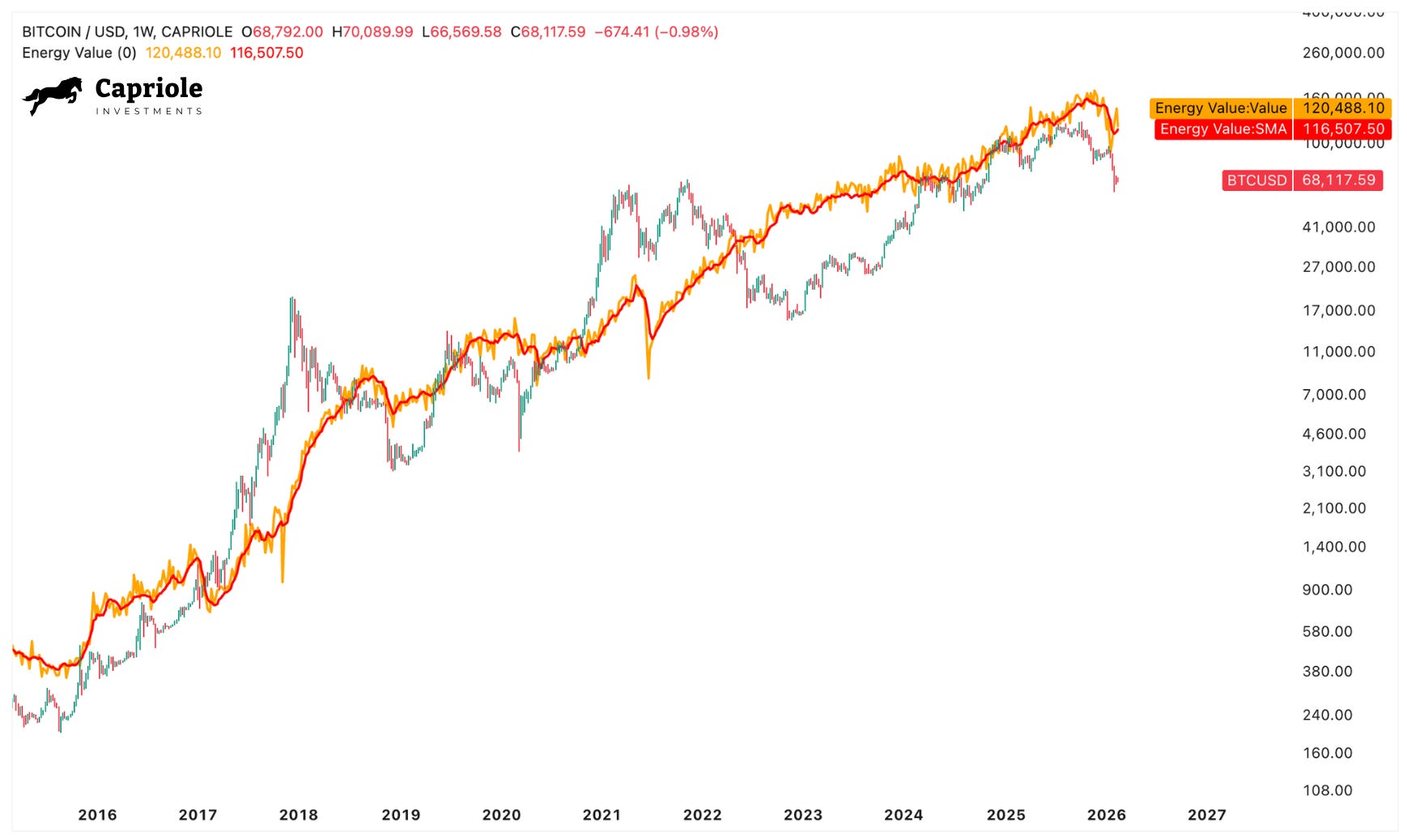
There are many models for estimating the fair value of Bitcoin. Our favourite is Bitcoin Energy Value. Feel free to choose your own Bitcoin valuation metric to apply this logic, but for this exercise we will use Bitcoin Energy Value.
We created Bitcoin Energy Value in 2019 and it has been unchanged since, this model has been a great tracker of Bitcoin’s fair through all history and since metric inception 7 years ago. It simply models the fair value of Bitcoin based on the energy used to mine it considering hash rates and the mining hardware energy efficiency. Energy Value represents the Raw “joules in” to produce a Bitcoin with no curve fitting, power laws nor exponents. A very simple robust model. Bitcoin Energy Value model calculation logic available here and the live chart is here.
Today Bitcoin’s Energy Value is $120K.
Applying the 2026 Quantum Discount Factor of 20%, Bitcoin’s fair value allowing for quantum risk is $96K.
That’s exactly why we started to get bullish on Bitcoin’s when it hit $60K in February 2026. Because even when you allow for quantum risk, Bitcoin is currently undervalued today by about 30%.
In other words if you are a long-term investor in Bitcoin, and optimistic we will solve on the quantum threat in the next 2-3 years, then Bitcoin in the $60,000s is an attractive long-term opportunity.
Mythbusting
Lets address some of the most common misconceptions about quantum computing and why Bitcoin is the number one target for a quantum hacker today.
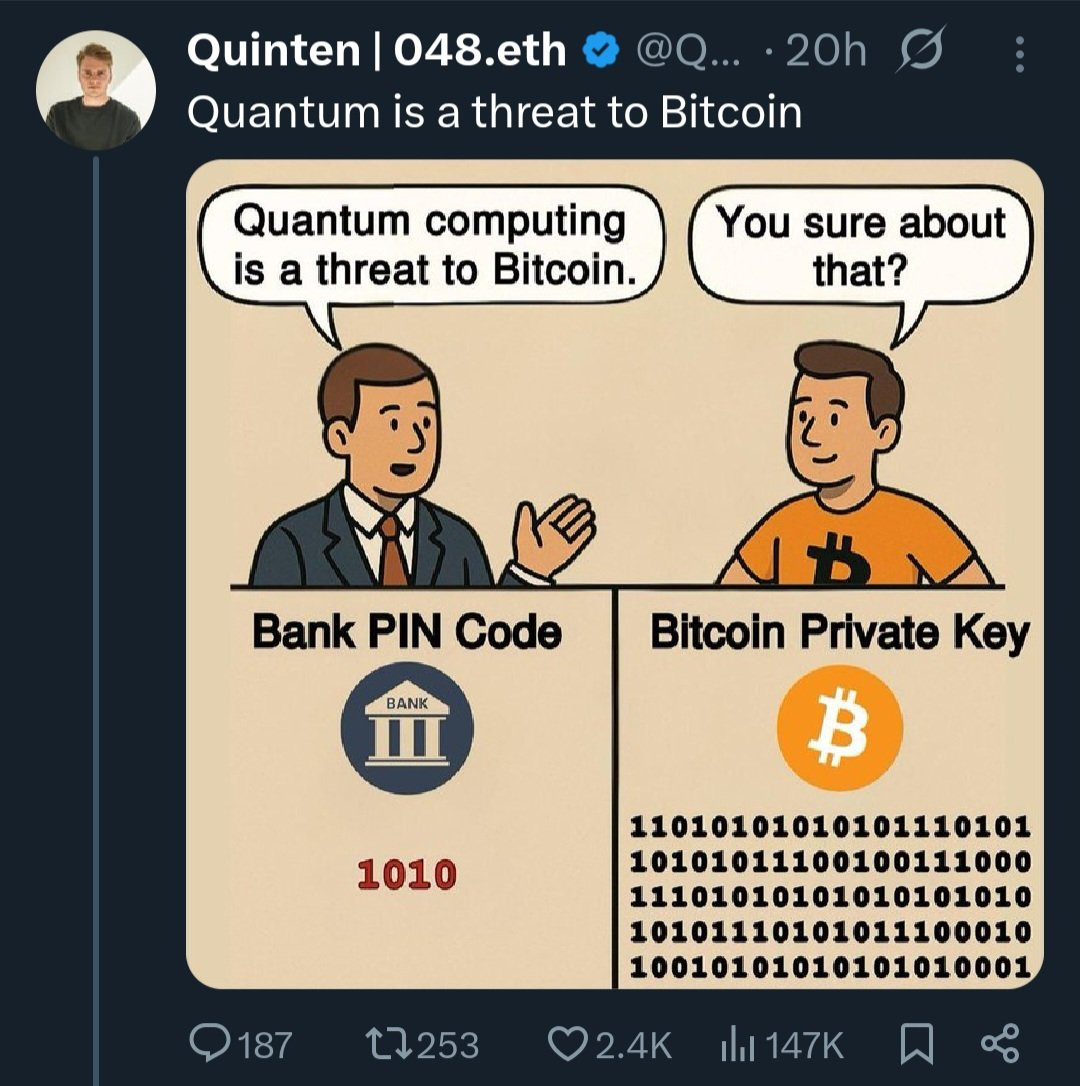
DEBUNKED: “Banks are more at risk from quantum than Bitcoin”
No, banks and other financial apps are at substantially lower risk of a quantum hack, here’s why:
- Post-quantum encryption. Many banks and financial applications have already begun migrating to post-quantum encryption already. Those that haven’t yet, as centralized institutions, can deploy such upgrades very quickly (within days and weeks, versus Bitcoin’s years).
- 2-FA is Quantum resistant today. Almost all financial applications and banks use two-factor authentication (2-FA) now. 2-FA codes render quantum computer superposition power useless in decryption. Quantum computers cannot simulate the large number of options for your verification codes, because by definition they can only be entered (tested) one at a time. You also only get a limited number of attempts to “guess” a 2-FA code before you get locked out. This makes 2-FA a great security tool to have set up today to protect against quantum attack.
- Bank Pin codes at no risk. For the same reason as 2-FA, bank pin codes are also not at risk. There is no quantum advantage to breaking a bank pin code that current modern day computers don’t already have. In theory a modern computer could guess all pin code combinations within a second, but they can’t be used to do so because there is (1) no technology interface to do this at scale as each is tied to a physical card, and (2) you only get a limited number of discrete attempts before lock out, again eliminating the value of quantum computing. Because of speed and cost, if you wanted to hack a bank card pin code, you would be far better off using a normal computer even post Q-Day.
- Transaction Reversals and Insurance. Tradfi banking hacks can be wound back. Banks are centralized institutions and can roll bank transactions. They can block wires. And when things go really wrong, they will refund you under insurance. Your risk of loss from hacking is negligible, even where security gaps exist. Bitcoin has none of these benefits.
- Bank Encryption is stronger than Bitcoin’s. Bitcoins’ cryptography (ECC) is weaker than RSA 2048: RSA is the common classical standard for encryption and authentication used by banks (before they started upgrading to post-quantum encryption). So even the (limited) number of banks that haven’t upgraded in time still have stronger encryption than Bitcoin because quantum computers will be able to break ECC breaks before RSA. Which is yet another reason why quantum hackers will target Bitcoin first.
Add all of the above 5 protections together and it’s very clear that your bank account is very likely not at risk from a quantum hack.
In the coming decade there will be a wave of quantum hacks across various applications. Much like we have seen many hacks and breaches over the last decade. Some platform security gaps and user errors will result in compromises. Some banks will have issues, but the vast majority likely won’t.
Remember, any issues on these centralized (including banking) platforms are often a simple database entry away from rectification. This is not the case for Bitcoin.
Bitcoin has eliminated the requirement for human or intermediary trust and it relies solely on the code. This is fantastic when the code works. But if it gets hacked, there are no refunds or rollbacks for stolen Bitcoin.
Even if Bitcoin were at lower risk, would that be an excuse for the most revolutionary financial product and first decentralized store of value carrying over $1T in value to ignore the quantum threat?
All of Bitcoin’s value hinges on trusting the code. That is not the case for any other financial institution or asset in the world. It is the code that is most at risk from quantum attack and it’s a threat vector that we need to solve today, and we have the technical means to do it. So let’s do it.
DEBUNKED: “quantum computers are too unstable and you will need millions of qubits to crack Bitcoin”
Let’s debunk another myth, that quantum computing is too error prone or unstable and that you need millions of physical qubits to trigger Q-Day.
Quantum computing error rates (what separates physical and logical qubit counts) are also reducing exponentially. Counterintuitively, according to Google in 2024, “the more qubits we use, the more we reduce errors, and the more quantum the system becomes.”
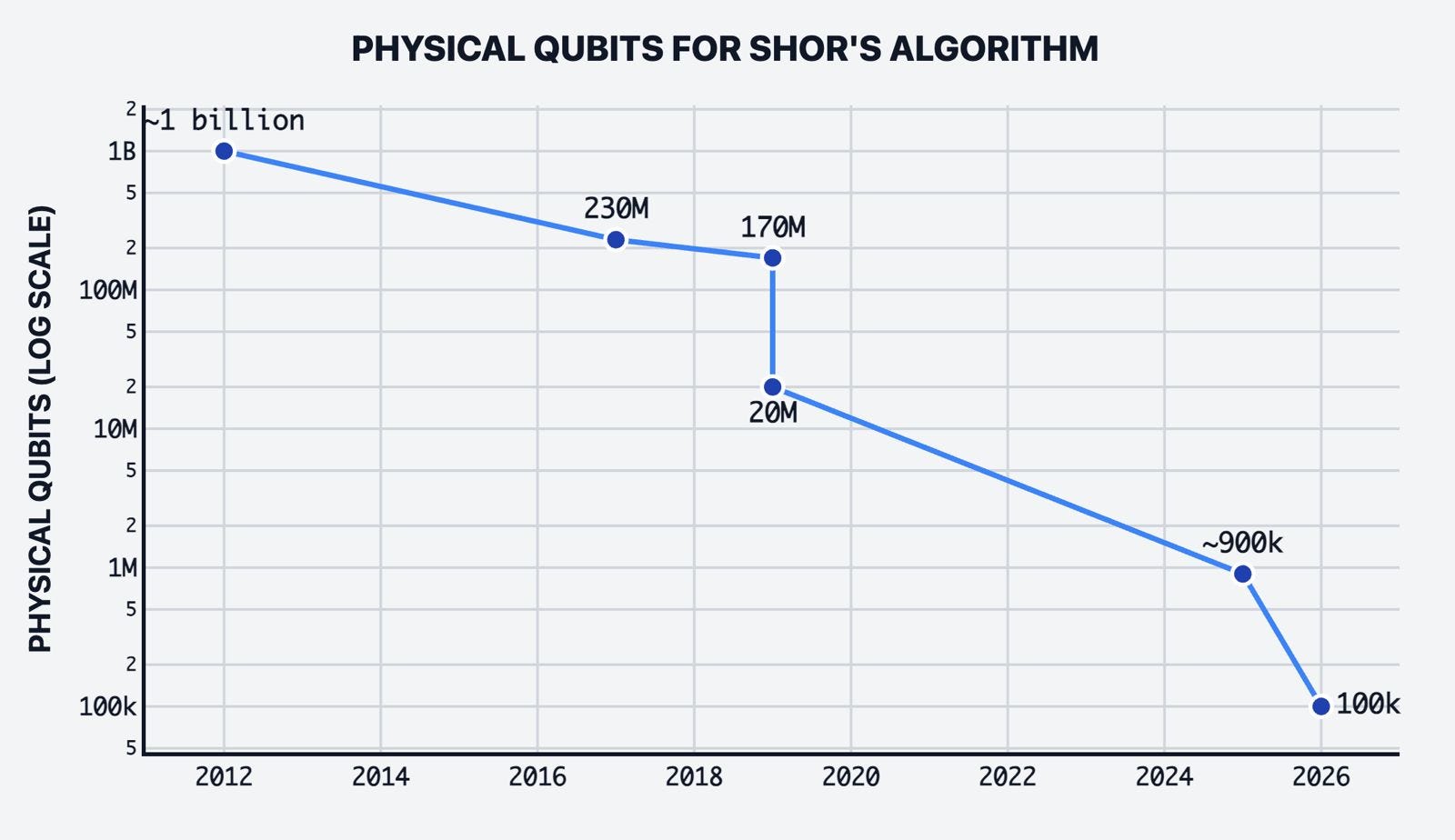
This has seen the number of physical qubits required to run shor’s algorithm and trigger Q-Day drop like a rock. Just 6 months ago you would have heard people say you need millions of qubits to break Bitcoin’s encryption. Well that number has plummeted and as of the latest research it’s only 100,000 physical qubits.
A year ago it was millions, 6 months ago it was 1 million, today just 100,000 physical qubits are needed to break RSA 2048, trigger Q-Day and breach Bitcoin’s cryptography.
How many qubits will be needed in a year?
Do the math. Follow the trend.
Bitcoin is the biggest quantum honeypot
In a quantum world, Bitcoin has the weakest security of any financial product. 20-30% of Bitcoin is public key exposed, including the early Bitcoin P2PK transactions, Satoshi’s coins and other lost coins. This means that when Q-Day hits, a hostile actor can plug away at decrypting these wallets one by one, with unlimited time available to solve the task. At first this may take hours or days for one decryption. Within months to years, each wallet will be decryptable within minutes.
Bitcoin is the perfect target for a quantum hacker, because there’s 24/7 liquidity and dozens or willing counterparties to trade with globally that do not care where you got the money from. Satoshi’s $100B+ wallet alone would fund the entire history, more than a decade, of global quantum computing R&D. While a legally questionable act, there are plenty of offshore entities that would be happy to see the downfall of Bitcoin and profit immensely from it. Bitcoin is banned in China, it’s also a cause of significant illegal capital outflows from their country, China has also spent double the USA on quantum computing research to date. Not long after Q-Day, anybody world wide will be able to access a cryptographically relevant quantum computer via their choice of cloud provider (Amazon, Google and Microsoft, etc) expanding the potential candidates for quantum hackers to 8 billion plus.
This makes Bitcoin the number one target for a quantum hacker.
Reasons for Optimism
There are reasons to be optimistic. Firstly, almost every major technology (and company) has stared down the barrel of despair where all outcomes looked bleak as it advanced up the S-curve. How many people dismissed Amazon, Tesla, SpaceX and countless other technologies when they faced unsurmountable hurdles, losses, near bankruptcy and technological failures. Human enterprizes have an incredible capacity to overcome the most challenging problems and it’s usually not very smart to bet against technology innovation in general when assessing the problems that exist today. They are all solvable. Including Bitcoin’s.

Just a month ago, Bitcoin had made no action on the quantum threat.
Today a few promising things have happened:
- A week ago: BIP360 was merged into Bitcoin. This is the first code change that is a stepping stone to quantum proofing Bitcoin. It does not address the key issues of quantum resistant signatures, but it’s a start.
- 2 weeks ago: Michael Saylor, decided to establish a Bitcoin Security program to tackle the issue. After Satoshi, Saylor’s Strategy company owns the most Bitcoin in the world. Well directed, his influence (and capital) could help fast track progress on resolving Bitcoin’s quantum threat.
- 3 weeks ago: the Ethereum Foundation established a dedicated team to address the quantum threat. Ethereum’s founder, Vitalik himself, recently acknowledged that both Bitcoin and Ethereum’s current cryptography “will die”, in reference to the possibility of Q-Day occurring before the next US election in 2028. While this Ethereum’s quantum team and funding doesn’t directly help Bitcoin, as the number two crypto asset, it’s a positive and influencing pressure.Michael Saylor finally acknowledges the quantum threat and establishes a Bitcoin Security program to address it in February 2026.
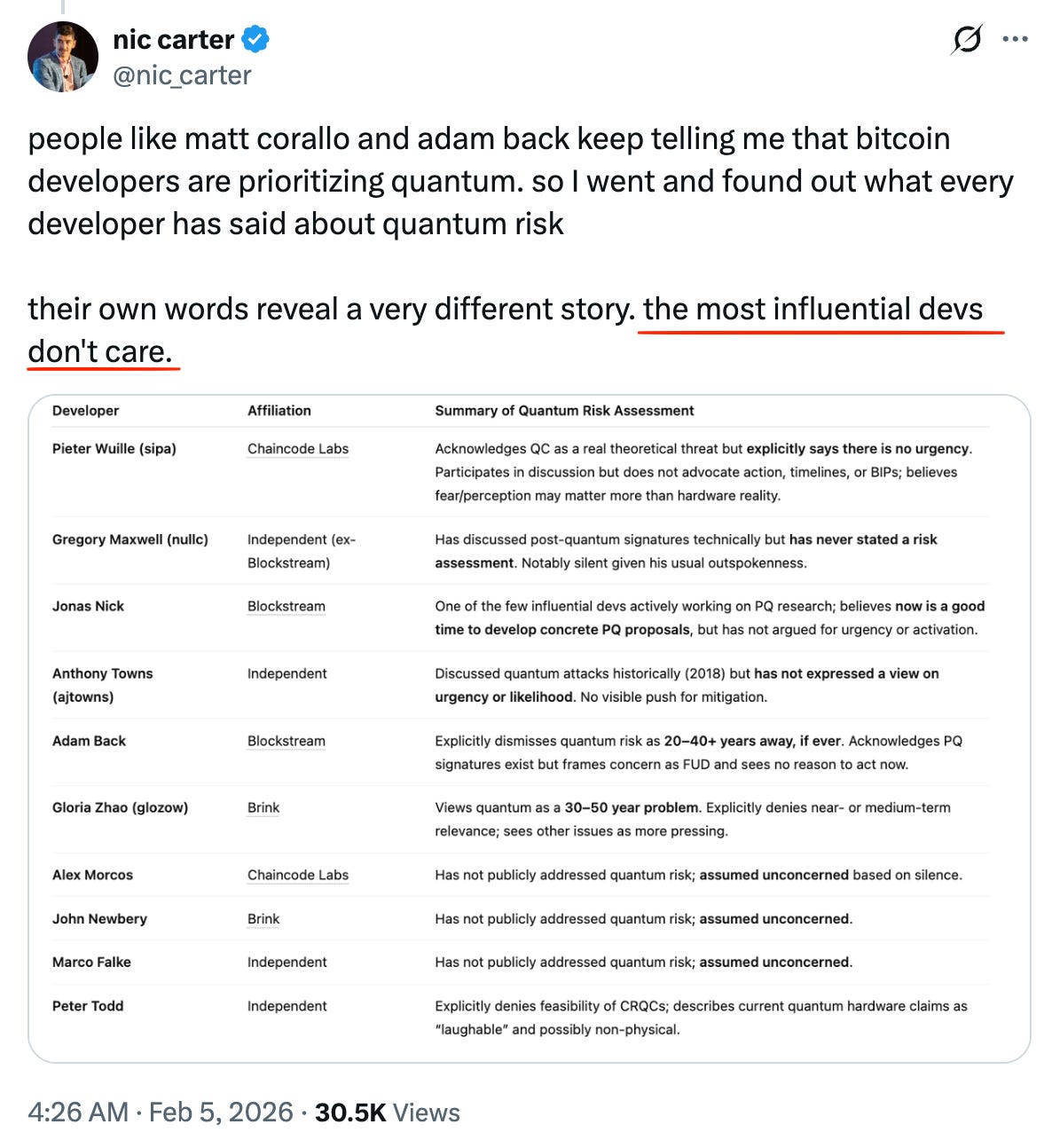
None of the above has shifted the public stance of key Bitcoin core developers on quantum yet, nor has it resulted in any proposed quantum resistant signature code for Bitcoin, so this progress does not reduce the current Quantum Discount Factor of 20%.
It’s a promising start to 2026, but we have a lot of work to do.
Every day, Q-Day gets closer. If we don’t make progress in upgrading, Bitcoin’s fair value will exponentially collapse.
We need to see key Bitcoin core developers driving action to a quantum proof solution.
We need to see a BIP with quantum resistant signatures.
We will also (ideally) see a BIP for the Dead Man’s Switch proposed in this article as well, to fully eliminate quantum risk to Bitcoin.
As soon as any of the above happens, a step change reduction in the quantum risk and the Quantum Discount factor that is applies to Bitcoin’s value will occur.
This could result in a significant and aggressive re-pricing of Bitcoin up in quicktime. A good old fashioned Bitcoin short squeeze. We don’t even need to have deployed code. The market is forward looking and will price a quantum solution in when it becomes a probability and provided it is early enough. I am hopeful this is something we will see over the next year.
Bottom Line
We hope this article will help inform around the current state of quantum computing and provides a useful framework to estimate a realistic timeline for when Q-Day will occur. It’s important that the average Bitcoiner understands how the market is now pricing in the quantum threat, and discounting its fair value. These risks are becoming broadly acknowledged and resulting in changes to how institutional investors allocate (and deallocate) to Bitcoin. In highlighting the urgency of the threat we hope to see the Bitcoin community rally around a solution in the near future.
If this article does nothing else but incite slightly faster progress on quantum proof code for Bitcoin, then it’s a great success.
If you legitimately want to maximize the value of Bitcoin now and into the future, you will support the movement of upgrading Bitcoin’s code in 2026.
Please share this article with everyone you know in Bitcoin space. More importantly, let’s get these facts and timelines in front of the principal Bitcoin core developer team. Even if they don’t believe it, a sufficiently large pool of quantum physicists, multi-billion-dollar quantum companies and large would-be Bitcoin allocators do.
If you want to see a prosperous future for Bitcoin, we must significantly progress solving the Quantum threat in 2026.
We can’t afford to be 1 day late on Q-Day.
![It is not the strongest of species that survives..." -Charles Darwin[638x359] : r/QuotesPorn](https://substackcdn.com/image/fetch/$s_!7yNg!,f_auto,q_auto:good,fl_progressive:steep/https%3A%2F%2Fsubstack-post-media.s3.amazonaws.com%2Fpublic%2Fimages%2F0044c5b0-f040-4311-a30d-6a7987b998c3_1080x601.png "It is not the strongest of species that survives...\" -Charles Darwin[638x359] : r/QuotesPorn")
Disclaimer
Capriole started out as a pure Bitcoin investing firm in 2019, but has since evolved across multiple asset classes from 2024 as risk vectors to Bitcoin have grown. Today Capriole trades directionally long/short in Bitcoin, crypto, equities and commodities as a systematic hedge fund. We rarely short Bitcoin (we’ve only been net long, or in cash, against Bitcoin in the last 6 months), so we have not benefited from Bitcoin’s recent decline. We have positions in some quantum computing stocks as a quantum hedge to Bitcoin’s quantum risk, we see this as prudent insurance until Bitcoin’s quantum threat is resolved. The size of this quantum hedge has grown from about 5% in 2024 to about 20% today (roughly equal to the Quantum Discount Factor and largely organically as the asset class has grown). We manage the quantum risk by reduced position sizing in digital assets, a quantum hedge, long/short directional trading and increasingly allocating to other high growth undervalued asset classes that have outperformed market benchmarks. It’s important to note that the value of US quantum stocks is totally unrelated to Bitcoin’s quantum threat, they will not benefit from a Bitcoin Q-Day event or media on Bitcoin’s risk, they can’t profit from digital crime. As of writing the Capriole Fund is long Bitcoin. In short – I do not benefit from Bitcoin’s demise or growing discussion of a quantum threat. To the contrary, it can be more costly in the short-term. However, not talking about the quantum threat and seeing no traction on quantum-proofing Bitcoin will result in a much more significant wipeout of Bitcoin’s value in the coming 5-10 years. So to maximize the net present value of Bitcoin today, and therefore its future value as well, we must speak up on the quantum threat to support action on its resolution as quickly as possible. Until that date, we actively use the tools and models presented in this article to manage our exposure risk to Bitcoin.